Key takeaway: While the global economy shows some resilience, its momentum remains extremely fragile and uneven, both across sectors and geographically.
Growth is being supported by investments in IT and an easing in financial markets. Counteracting factors include trade turbulence, pessimistic investor sentiment, and prevailing uncertainty.
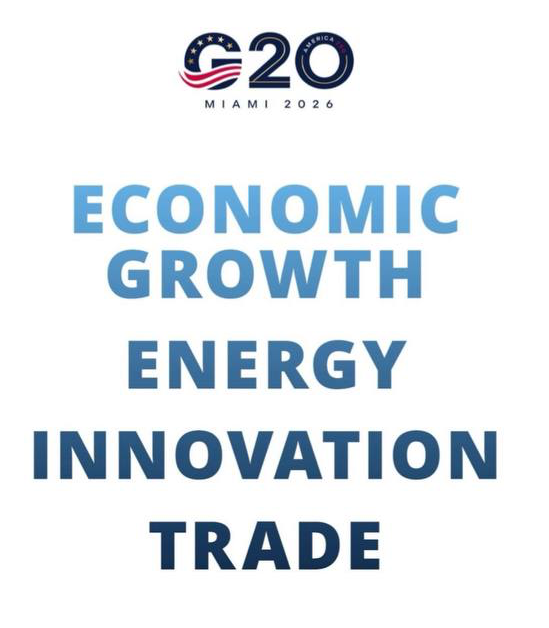
In the context of the priorities of the US presidency of the #G20, the following points are of interest:
📈 Economic Growth. According to the IMF, global growth rates in 2026–2027 will hold steady at 3.3% and 3.2% (the UN expects more modest figures of 2.7–2.9%). For developed economies, the forecast is 1.8% and 1.7%. In the Eurozone, the rate is projected at 1.3–1.4%, essentially sustained by increased state spending on military needs.
The engines of growth continue to be emerging market economies, that is, members of #BRICS and other representatives of the Global South/East: their projected figures are 4.2% and 4.1%.
The average growth rate for the G20 in 2026, as calculated by the OECD, is 2.9%.
📉 Inflation is expected to slow further (from 4.1% in 2025 to 3.8% in 2026 and 3.4% in 2027). However, as the UN underscores, in a number of developing countries in Asia and Africa, this indicator remains excessively high, especially for basic consumer categories—housing, food, electricity.
The main risks, as before, include potential “bubbles” in the AI sector; an escalation of trade confrontation (in the form of tariff wars, export bans on critical raw materials); and a worsening of geopolitical tensions. In finance, risks involve the escalating issues in non-bank financial institutions and digital financial assets.
Special attention is paid to the deteriorating situation with public debt in certain major economies whose national currencies and government securities hold systemic importance for financial markets.
📊 Trade. According to the IMF, the growth rate of cross-border commerce will slow from 4.1% in 2025 to 2.6% in 2026 (according to UN and OECD estimates, to 2.3% and 2.2% respectively). The UN notes a transformation in its geography, marked by a sustained increase in the share of emerging market economies (particularly Southeast Asia, which are key Russian partners), a consolidation of regional ties, and an expansion of South-South cooperation. Nevertheless, as of September 2025, about 72% of all trade turnover was conducted under the WTO’s fundamental principle of Most Favoured Nation treatment.
💻 Artificial Intelligence. AI technologies are viewed both as a significant factor in boosting labour productivity (their adoption in the medium term could add 0.1–0.8 percentage points to global growth rates) and as a serious source of risk.
It is confirmed that the potential benefits from applying these innovations are concentrated within a narrow group of countries, threatening to worsen inequality.
🔋 Energy. Against a backdrop of cooling demand and increasing supply, the IMF forecasts an 8.5% decrease in oil prices in 2026, while fluctuations in natural gas prices are expected to remain within a moderate range. Concurrently, emphasis is placed on a surge in electricity demand due to the rapid development of AI.
📄 Regulatory “Reset.” In line with the core theme of the US “watch” in the G20, one of the key recommendations from the aforementioned organisations is the accelerated implementation of structural reforms and a reduction in administrative barriers for businesses to stimulate commercial activity and innovation.
🤝 Success in overcoming current challenges is also conditioned on the ability of states to establish effective multilateral cooperation (with trade “détente” being a priority).
We would like to draw attention to a new approach by the US presidency regarding the involvement of international organisations in G20 events. This year, their participation in meetings on equal footing with full-fledged members is not anticipated. They will be engaged primarily to prepare reports at the request of working groups and will be present only at specialised meetings to present and discuss documents.
Photo source: Presidency materials, un.org
Growth is being supported by investments in IT and an easing in financial markets. Counteracting factors include trade turbulence, pessimistic investor sentiment, and prevailing uncertainty.
In the context of the priorities of the US presidency of the #G20, the following points are of interest:
📈 Economic Growth. According to the IMF, global growth rates in 2026–2027 will hold steady at 3.3% and 3.2% (the UN expects more modest figures of 2.7–2.9%). For developed economies, the forecast is 1.8% and 1.7%. In the Eurozone, the rate is projected at 1.3–1.4%, essentially sustained by increased state spending on military needs.
The engines of growth continue to be emerging market economies, that is, members of #BRICS and other representatives of the Global South/East: their projected figures are 4.2% and 4.1%.
The average growth rate for the G20 in 2026, as calculated by the OECD, is 2.9%.
📉 Inflation is expected to slow further (from 4.1% in 2025 to 3.8% in 2026 and 3.4% in 2027). However, as the UN underscores, in a number of developing countries in Asia and Africa, this indicator remains excessively high, especially for basic consumer categories—housing, food, electricity.
The main risks, as before, include potential “bubbles” in the AI sector; an escalation of trade confrontation (in the form of tariff wars, export bans on critical raw materials); and a worsening of geopolitical tensions. In finance, risks involve the escalating issues in non-bank financial institutions and digital financial assets.
Special attention is paid to the deteriorating situation with public debt in certain major economies whose national currencies and government securities hold systemic importance for financial markets.
📊 Trade. According to the IMF, the growth rate of cross-border commerce will slow from 4.1% in 2025 to 2.6% in 2026 (according to UN and OECD estimates, to 2.3% and 2.2% respectively). The UN notes a transformation in its geography, marked by a sustained increase in the share of emerging market economies (particularly Southeast Asia, which are key Russian partners), a consolidation of regional ties, and an expansion of South-South cooperation. Nevertheless, as of September 2025, about 72% of all trade turnover was conducted under the WTO’s fundamental principle of Most Favoured Nation treatment.
💻 Artificial Intelligence. AI technologies are viewed both as a significant factor in boosting labour productivity (their adoption in the medium term could add 0.1–0.8 percentage points to global growth rates) and as a serious source of risk.
It is confirmed that the potential benefits from applying these innovations are concentrated within a narrow group of countries, threatening to worsen inequality.
🔋 Energy. Against a backdrop of cooling demand and increasing supply, the IMF forecasts an 8.5% decrease in oil prices in 2026, while fluctuations in natural gas prices are expected to remain within a moderate range. Concurrently, emphasis is placed on a surge in electricity demand due to the rapid development of AI.
📄 Regulatory “Reset.” In line with the core theme of the US “watch” in the G20, one of the key recommendations from the aforementioned organisations is the accelerated implementation of structural reforms and a reduction in administrative barriers for businesses to stimulate commercial activity and innovation.
🤝 Success in overcoming current challenges is also conditioned on the ability of states to establish effective multilateral cooperation (with trade “détente” being a priority).
We would like to draw attention to a new approach by the US presidency regarding the involvement of international organisations in G20 events. This year, their participation in meetings on equal footing with full-fledged members is not anticipated. They will be engaged primarily to prepare reports at the request of working groups and will be present only at specialised meetings to present and discuss documents.
Photo source: Presidency materials, un.org